AI's trillion-dollar build-out and its missing payoff
Two reports out the same day show the gap between AI's trillion-dollar build-out and the productivity boom that was supposed to justify it -- and the missing mass white-collar layoffs.
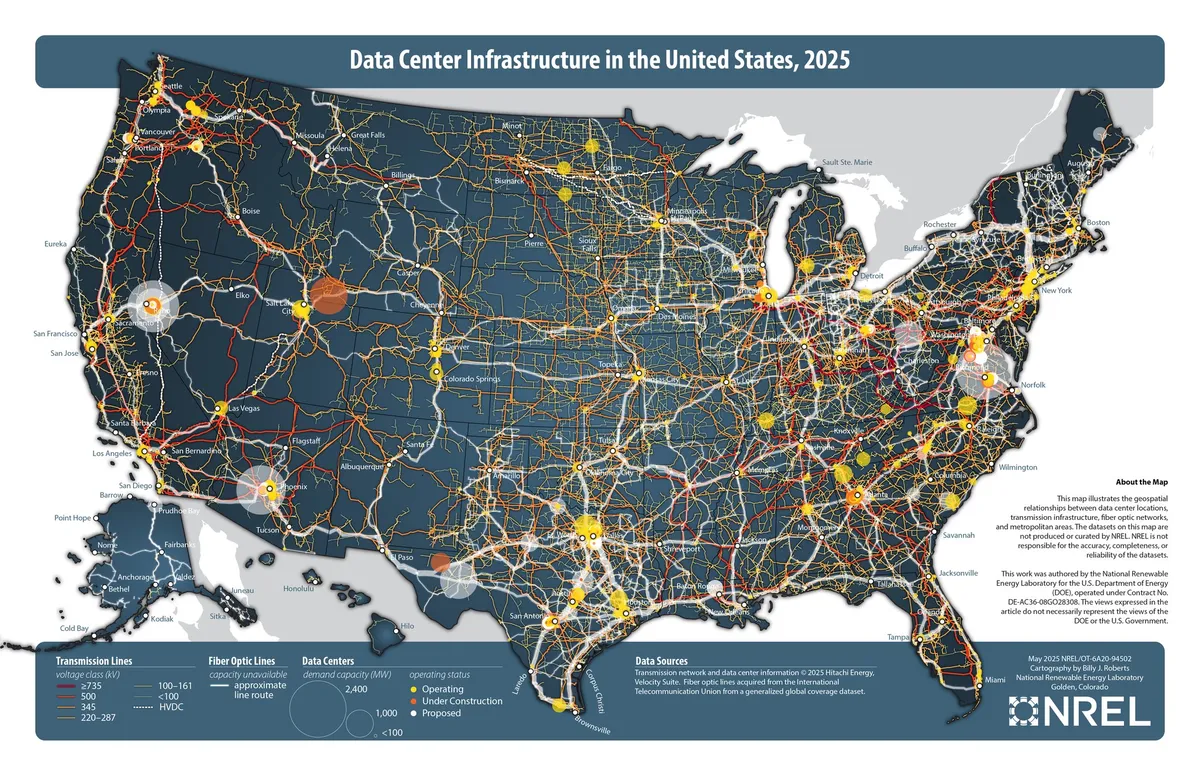

Last summer the consensus story on AI was an industrial revolution: trillions in new infrastructure spending would eventually pay for itself in a productivity boom that would let the Federal Reserve ease up on its inflation fight, while the technology quietly rewrote which white-collar jobs were worth keeping. A year on, neither half of that story has arrived. Two reports published the same day — one on the cost side, one on the labor side — make that gap unusually concrete.
Goldman Sachs Research now estimates US AI capital expenditure will reach $581 billion this year, on its way to as much as $1 trillion globally by 2028 — roughly 1.8% of US GDP today, climbing toward 2.8% by the end of the decade. That spending is doing exactly what a capital cycle of that size would be expected to do: bidding up the price of electricity, advanced chips, software, and the data-center capacity to house them. Inflation in those specific inputs has begun showing up in broader price gauges, leaving Fed Chair Kevin Warsh with the uncomfortable situation of trying to cool an economy whose hottest component is the very investment supposed to deliver the productivity gains that would justify it. As CNBC’s reporting makes clear, the productivity boom that would offset the price pressure has not yet arrived.
The same morning, a Stanford Institute for Economic Policy Research analysis was putting numbers on the other half of the pitch. Among the 20% of workers most exposed to AI, unemployment has risen 0.77 percentage points since 2022. Among the 20% least exposed, it has risen 0.85 points — slightly more. The “AI job apocalypse” predicted by Dario Amodei of Anthropic and Sam Altman of OpenAI — mass displacement of white-collar work on a short timeline — has not shown up in the labor statistics. The Guardian’s reporting finds instead that employers are quietly reframing AI as augmentation rather than replacement, and 74% of employers now list AI skills as a requirement in postings they previously would not have.
The two findings look contradictory at first, and in one sense they are. On the cost side, AI is acting like a classic capital-intensive shock: large enough to register in the CPI, concentrated enough to distort the price of the things it depends on, and arriving well ahead of any measurable payoff. On the labor side, AI is acting like a slow-moving skills filter rather than a substitution event: workers are being asked to use it, not replaced by it, and the people whose jobs are theoretically most exposed are, if anything, doing marginally better than the rest. A trillion-dollar build-out and a labor market that has barely budged are not the same story, and a year ago they would not have been forecast to coexist.
Read together, though, they describe the same gap from opposite ends. The investment is real — power purchase agreements, fab capacity, long-term compute contracts — and the labor adjustment is real, but in the form of a rising skill bar rather than the mass layoffs the loudest voices in the industry had warned about. Both stories agree on the underlying problem: the long-promised productivity and employment payoff has not arrived, and the distance between the hype cycle and what the data will support is widening rather than closing. The Fed is being asked to take the productive return on faith while measuring the cost in real time; employers are being asked to take the displacement narrative seriously while their hiring data tells them a quieter story.
What is unusual is not that either of these dynamics is happening on its own. Capital cycles drive up the cost of the things they depend on, and skill shifts rarely show up as a single quarter of layoffs. What is unusual is doing both at once, at this scale, and finding that the predicted offset — faster output per worker, fewer people needed to do the same work — is the one piece missing from the picture. The infrastructure is being built. The labor market is being reshuffled. The productivity number that connects the two has not yet moved enough to make either side of the bet look cheap.