First globular cluster stellar stream beyond Milky Way discovered in UGC 9050-Dw1, enabling new dark matter mapping method
Astronomers have confirmed the first globular cluster stellar stream beyond the Milky Way in the ultra-diffuse galaxy UGC 9050-Dw1, using Hubble archival data to enable a new method for mapping dark matter in distant galaxies.
.jpg)
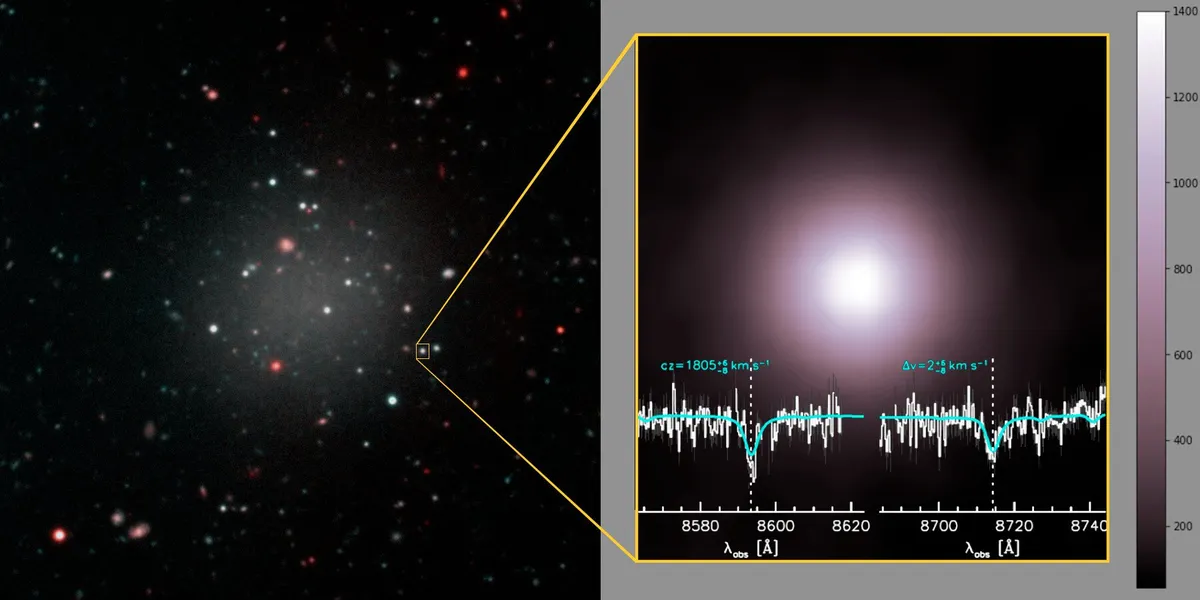
Astronomers have identified the first globular cluster Stellar stream beyond the Milky Way, a structure confirmed to reside in the ultra-diffuse galaxy UGC 9050-Dw1 roughly 115 million light-years from Earth. The findings, published August 12, 2026, present the first evidence of such a stream outside our galactic neighborhood.
The detection relied on archival data from the Hubble Space Telescope, with the results reported publicly one day after the Nature publication on August 13, 2026. The stream’s identification in UGC 9050-Dw1 marks the first confirmed example of a globular cluster stellar stream outside the Milky Way, detected via Hubble’s existing observational records.
Prior to this discovery, all known globular cluster stellar streams were confined to the Milky Way, limiting dark matter mapping efforts to our own galactic vicinity. The new extragalactic detection offers a method to measure dark matter in distant galaxies, as outlined in coverage of the August 12 Nature publication.
UGC 9050-Dw1 is classified as an ultra-diffuse galaxy, with far fewer stars than the Milky Way. The 115 million light-year distance to the galaxy places it well beyond the Milky Way’s immediate satellite system, where all previous globular cluster stellar stream detections were located.
The new method for mapping dark matter enabled by the stream allows astronomers to study cosmic structure in a system far removed from the Milky Way’s local environment. Previously, such measurements were restricted to the Milky Way and its immediate neighbors, where globular cluster stellar streams have long been documented.
All three sources covering the discovery report broad agreement on the findings, with no contradictions between the peer-reviewed Nature study, the Hubble archival data, or subsequent public reporting. The August 12 and 13, 2026 publication dates reflect the standard timeline for scientific results moving from peer-reviewed publication to public coverage.