A 25-Year-Old Hubble Spectrum Just Solved a Cold Case in Planetary Formation
A re-analysis of 1999 Hubble data on white dwarf HS 0209+0832 reveals niobium signatures pointing to the first suspected second-generation planet — a Jupiter-sized world formed from the cast-off material of a dying star.
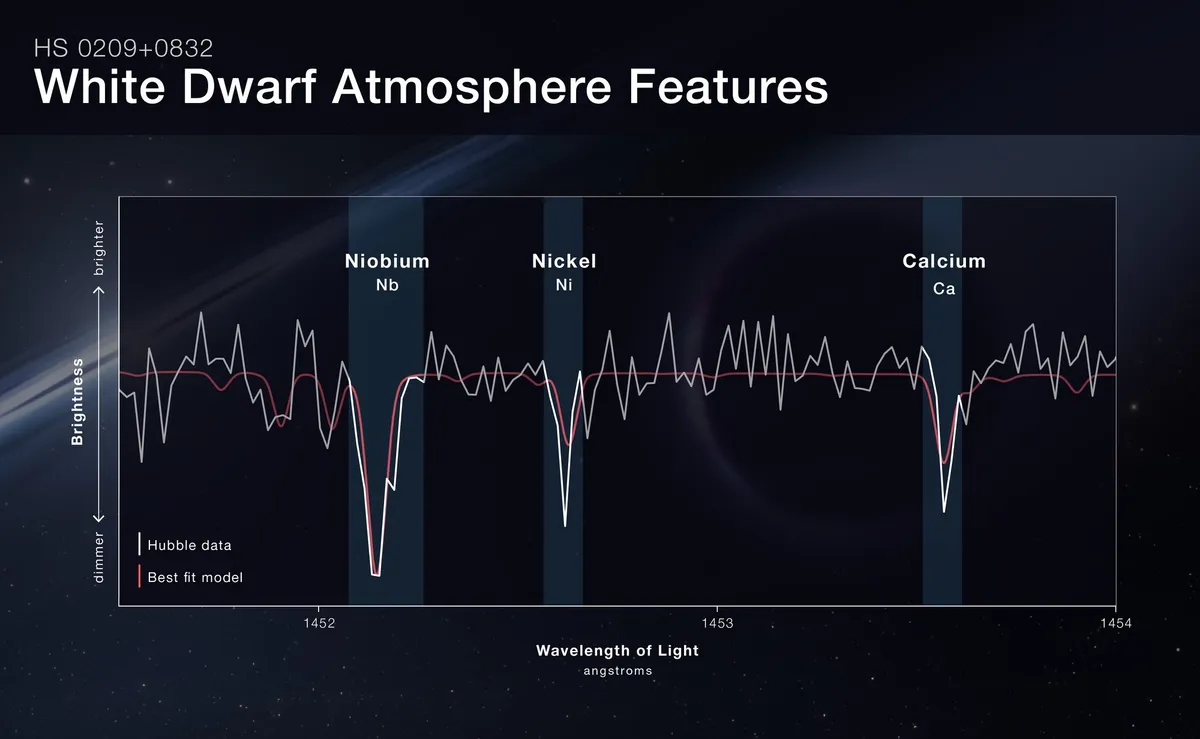

Twenty-five years ago, the Hubble Space Telescope recorded spectra of a white dwarf star now catalogued as HS 0209+0832, and the data sat in archives with a handful of chemical signatures no one could place. An international team drawing on the University of Warwick, the Instituto de Astrofísica de Canarias, MIT, the University of Wisconsin, the Center for Astrophysics, LASP at CU Boulder, and the Space Telescope Science Institute went back to those 1999 observations this month and matched the unidentified features to niobium — closing what NASA’s Hubble Mission Team is calling a surprising chemical clue that the star may host a second-generation planet, a result published Monday in Nature Astronomy.
The host is a white dwarf, the dense stellar remnant left after a sun-like star sheds its outer layers in its final act. HS 0209+0832 is not unusual in kind; what is unusual is the composition signature now visible in its atmosphere, and specifically the presence of an element that should not have been there unless the star’s own death provided the raw material for something new to form around it.
Niobium is the linchpin of the argument. It does not get synthesised in the cores of stars during their main lives; it is produced only in the extreme nuclear conditions at work during the death throes of dying stars. Finding it in the spectrum of a white dwarf’s vicinity is, in principle, unremarkable — the element was made by the ancestor star and can linger in the ejecta. What is remarkable is finding it in a pattern consistent with a bound planetary body rather than a diffuse debris disk, and the team reports this as the strongest evidence yet for a second-generation gas giant: a world that forms around the stellar remnant from its cast-off material, rather than condensing from the original molecular cloud the star itself was born in.
The candidate the team describes is a gas giant comparable in size to Jupiter, orbiting roughly six million kilometres from the star. That distance puts it in a regime where the white dwarf’s residual radiation has had decades of millions of years to heat and sculpt any freshly accreted material, and the Jupiter-scale mass implies a substantial reservoir of heavy elements — consistent with a disk of niobium-enriched ejecta collapsing under gravity after the progenitor star finished its planetary nebula phase.
What made the identification possible was not new telescope time but a new reference. The team used an updated chemical database to re-map the 1999 spectral lines against a broader and more accurate set of elemental signatures. The lines were in the data all along; the catalogue simply hadn’t had the right entries to flag them. University Today’s account of the paper notes that the niobium signatures were previously unidentifiable because the element’s spectral fingerprints had been misassigned or overlooked in earlier chemical models, and that the updated database resolved the ambiguity in one pass.
The significance is less about a single planet than about a pathway. Standard planet-formation models describe worlds condensing from the same primordial disk that built their host star. A second-generation planet inverts that sequence: the star dies first, sheds its envelope, and the leftover material — now enriched in elements that never existed in bulk during the star’s living years — re-accumulates into a new body. If the niobium attribution holds up under follow-up spectroscopy with larger facilities, it would be the first time that pathway has been traced through to a specific gas giant rather than an abstract disk remnant.
For now the case remains a strong suspicion rather than a confirmed detection. The team is explicit that the spectral match points to niobium and that the planetary interpretation is the most natural explanation for the isotopic and abundance pattern, but a single set of 1999 Hubble lines, however newly decoded, is not the same as a mass measurement or a transit signal. The archive, though, is no longer a cold case. The fingerprints were on the file all along; twenty-five years of better chemistry was all it took to read them.