A decagon has appeared at Saturn's south pole
Hubble images and a new Science Advances paper confirm a giant 10-sided atmospheric wave circling the planet — the first large, regular-sided jet pattern ever seen in Saturn's southern hemisphere.
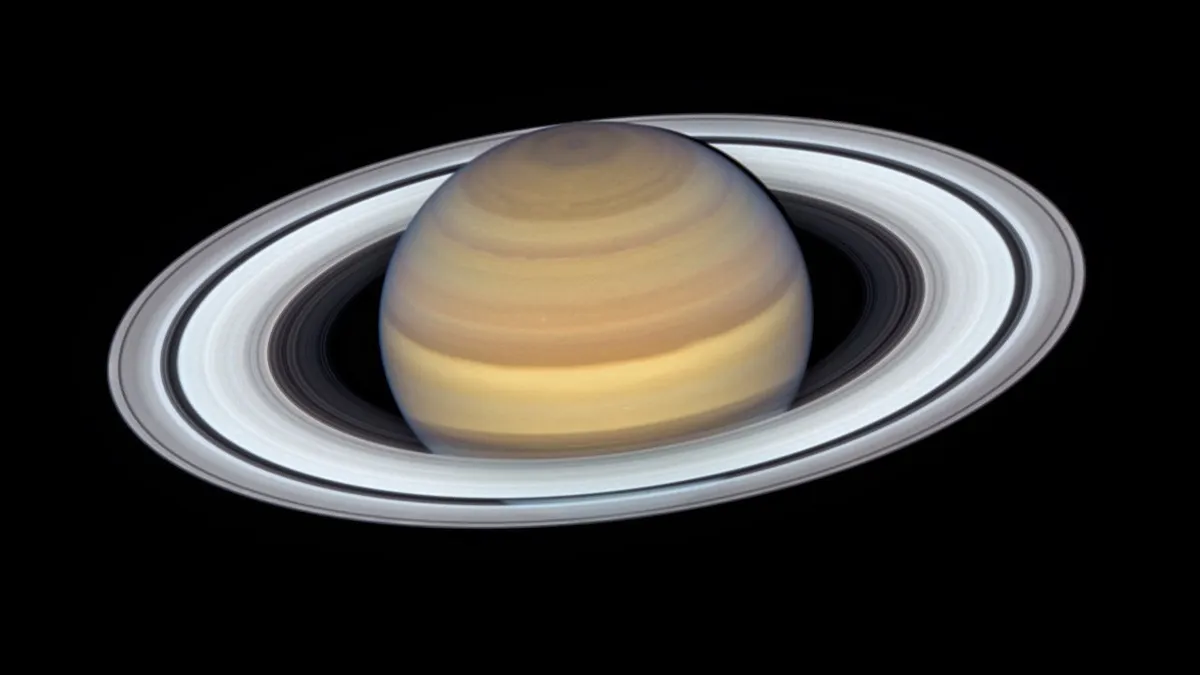

Saturn already had one famous polygon. A persistent hexagon has been churning above its north pole since at least the early 1980s, documented through the Voyager flybys, the Cassini mission, and most recently by the Hubble Space Telescope. On September 2, NASA announced that Hubble has now caught a second one — and this time, it’s a decagon, and it has formed at the south pole instead.
The discovery comes out of the Outer Planets Atmospheres Legacy (OPAL) program, Hubble’s long-running survey of the outer planets, and is detailed in a Science Advances paper led by Agustín Sánchez-Lavega and colleagues. The pattern first showed up as a faint 10-vertex polygon in Hubble/OPAL images from October 2023, near the latitude band at roughly 63°S where a strong eastward jet stream runs through Saturn’s atmosphere. By August 2024 it had sharpened; by August–September 2025, it was fully formed.
The timing is part of why the feature is so strange. Saturn’s south pole was effectively out of view from 2012 through most of 2023, the planet’s axial tilt pointing the south down and away from Earth. Cassini, which orbited Saturn from 2004 to 2017, took thousands of high-resolution images of the southern hemisphere during that window and saw nothing like it. According to reporting in Smithsonian Magazine, amateur astronomers were the first to flag the polygon after the pole rotated back into view in 2024 — a reminder that a carefully watched backyard telescope, pointed at the right place at the right time, can still beat the flagship observatories to a new atmospheric feature.
What the polygon actually is, physically, is a standing wave in the jet stream — a regular oscillation of the atmospheric flow around the latitude band that, when viewed from above, resolves as a 10-sided pattern. Sánchez-Lavega’s team characterizes it as the first large, regular-sided jet pattern ever observed in Saturn’s southern hemisphere, and one that extends vertically through multiple layers of the atmosphere rather than sitting in a single cloud deck. NASA’s Amy Simon, OPAL’s principal investigator, told the press that the feature “seems to have just formed recently” and described it as a new atmospheric phenomenon that is still strengthening. The plan from here is to bring JWST into the analysis and run numerical models of the jet stream to figure out why ten sides, why now, and why there.
That last question is the one that keeps this from being a simple case of “Saturn does polygons.” The northern hexagon has been stable for decades, and the leading explanation for it has long been that the deep atmosphere sets the wavelength — that something about Saturn’s interior and the structure of the jet stream just naturally locks into six-sided flow. If the south pole has now spun up a ten-sided wave in the same kind of jet, with a similar mechanism plausibly responsible, that weakens the case for a single, deep-seated cause. As Sánchez-Lavega put it to Smithsonian Magazine, the northern hexagon may turn out to be “not as extraordinary as we thought” — one stable answer among several that a giant planet’s atmosphere is capable of producing, rather than a unique fingerprint of its interior.
For now, the decagon is still a moving target. Simon notes it is strengthening rather than settling, and the OPAL team is already pulling together follow-up Hubble observations to watch how the wave evolves over the next few apparitions. JWST, with its much higher spectral resolution in the infrared, should be able to pin down how deep into Saturn’s atmosphere the pattern reaches and what it’s doing to temperature and composition as it goes. Whether the decagon stabilizes into a decades-long fixture like its northern cousin, or dissipates back into the jet stream within a few years, is the question that will determine which of those two readings of the discovery holds up — a small adjustment to how we think about Saturn’s weather, or a much larger one.
Sources
- NASA’s Hubble Tracks New Decagon Encircling Saturn’s South Pole — NASA Science (official NASA Hubble Mission Team / Goddard Space Flight Center)
- A Mysterious Decagon Unexpectedly Appeared Around Saturn’s South Pole — Smithsonian Magazine
- Astronomers Discover Decagonal Wave circling Saturn’s South Pole — Sci.News