ALMA Captures Trillion-Mile Gas Streamer Feeding GW Orionis
ALMA has mapped a trillion-mile gas streamer feeding the triple-star system GW Orionis, revealing how late-stage infall from the surrounding molecular cloud tilts and reshapes the protoplanetary disks where planets form.
_(eso2014b).jpg)
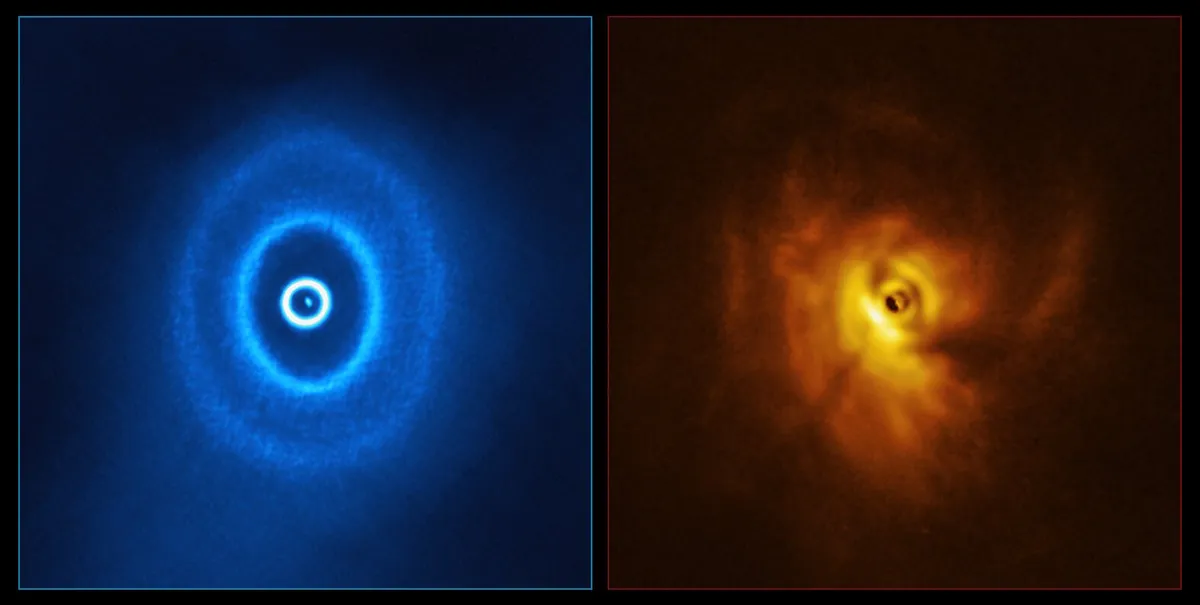
ALMA has mapped a roughly one-trillion-mile gas streamer feeding the young triple-star system GW Orionis, capturing the clearest evidence yet for how late-stage infall from a surrounding molecular cloud can tilt and reshape the disks where planets are born. The observation of GW Orionis reveals a streamer stretching approximately 12,000 astronomical units — about 0.2 light-years — and containing roughly 1.6 Jupiter masses of gas threading toward the system’s center.
The streamer’s trajectory lines up closely with the outer dust ring but is strongly misaligned with the inner ring, providing the clearest evidence yet for how streamers can tilt and twist protoplanetary disks during the late stages of star formation. This misalignment matches the geometry of the system’s warped rings, suggesting the streamer is actively feeding material into the outer disk while exerting gravitational influence that tilts the inner regions.
The finding clarifies a long-standing question about GW Orionis, whose three central stars host a protoplanetary disk broken into distinct rings tilted at different angles. Earlier models struggled to explain how such a massive disk could become so misaligned without dispersing; the trillion-mile streamer offers a mechanism, showing that infall from the surrounding molecular cloud can persist far longer than the initial collapse phase, continuing to sculpt planetary birth environments millions of years after the stars themselves formed.
Systems like this challenge the assumption that planet-forming disks settle into flat, orderly structures aligned with their host stars. Instead, gas can arrive from reservoirs extending light-years away, carrying angular momentum that tilts or warps the disk as it accretes. With 1.6 Jupiter masses of material still flowing inward, the streamer demonstrates that the final architecture of a planetary system may depend on late, chaotic deliveries rather than the smooth, isolated evolution often assumed in formation models.
For astronomers studying how planets emerge in multi-star environments, the ALMA observations provide a concrete case study of disk-torquing in action. The trillion-mile bridge between interstellar cloud and circumstellar disk shows that planetary systems can be shaped by material arriving from vast distances, long after their host stars have stabilized—a process that may prove common in the crowded stellar nurseries where most stars are born.