Astronomers Resolve 44 Nysa as a Three-Lobed Asteroid with a Small Moon
Astronomers have resolved 44 Nysa as a rare three-lobed asteroid accompanied by a small moon.
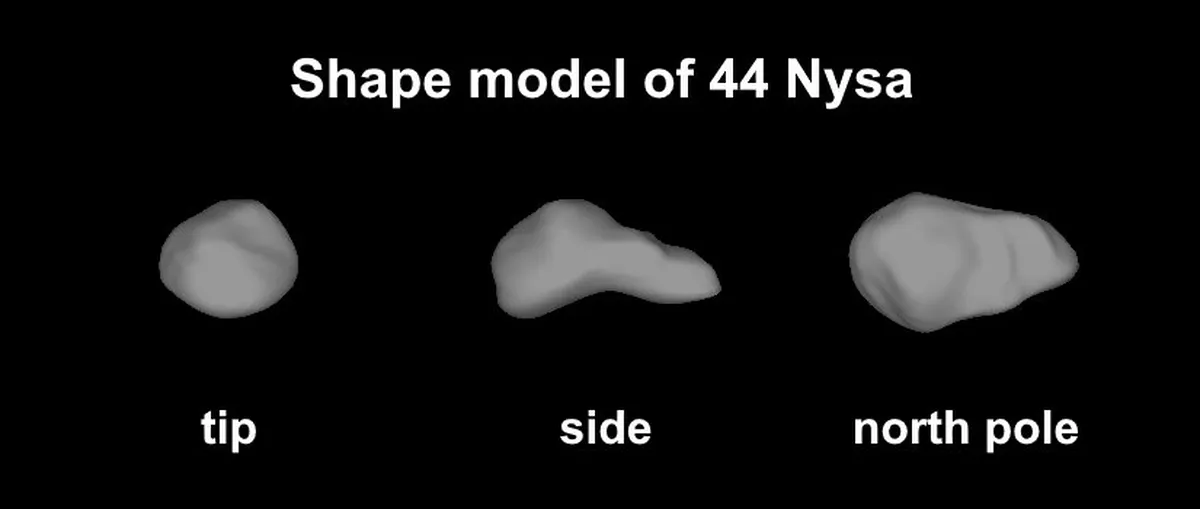

Adaptive-optics observations have turned 44 Nysa from an apparently ordinary asteroid into something considerably stranger: a body that appears to consist of three connected lobes, joined by narrow necks, with a small moon moving around it. The shape is not an artist’s interpretation of a blurry point of light. Astronomers have resolved the asteroid’s structure directly in observations made with large ground-based telescopes.
The observations described by Sky & Telescope show three lobes connected by narrow necks, along with a kilometer-scale moon orbiting about 180 km from Nysa’s center of mass. That combination makes Nysa unusual in two separate ways: its primary body is visibly trilobate, and the system includes a satellite large enough to be resolved alongside it.
Images from the Very Large Telescope and the Large Binocular Telescope provide the other view of the result. Those images are believed to show the first known trilobate asteroid, with a roughly 1-km moon orbiting at about 170 km. The two reported orbital distances are close enough to describe the same compact arrangement, while the difference reflects the measurements as presented by the two reports rather than a disagreement about what the system contains.
A three-lobed asteroid is an especially striking object because the lobes are not separate bodies traveling in formation. They are connected into one resolved shape, with the narrow necks providing the visual evidence that the object is a single, highly irregular body. The moon adds another layer to the picture: Nysa is not merely a peculiar silhouette, but a small gravitational system with a primary and a satellite.
The result also shows what adaptive optics can recover from observations made through Earth’s atmosphere. Without that correction, a distant asteroid can remain an unresolved point, hiding the distinction between one compact object and several connected masses. Here, the combination of high-resolution imaging and the moon’s orbit makes the structure legible in a way that ordinary observations would not.
For now, the important result is observational rather than speculative. Astronomers have identified 44 Nysa as a rare three-lobed body and found a small moon accompanying it, giving the asteroid an unusual architecture that can be studied as a system rather than as an isolated rock. A body that once occupied a single point in a telescope image now has a shape, connected necks, and a companion moving around it.