Stellar Stream Distortions May Be the Galaxy's Own Work, Not Dark Matter
University of Washington simulations of roughly 15,000 stellar streams show the Milky Way's own gravitational structure produces kinks, gaps, and bends that look identical to dark matter subhalo signatures — complicating one of the field's leading indirect detection methods.
.jpg)
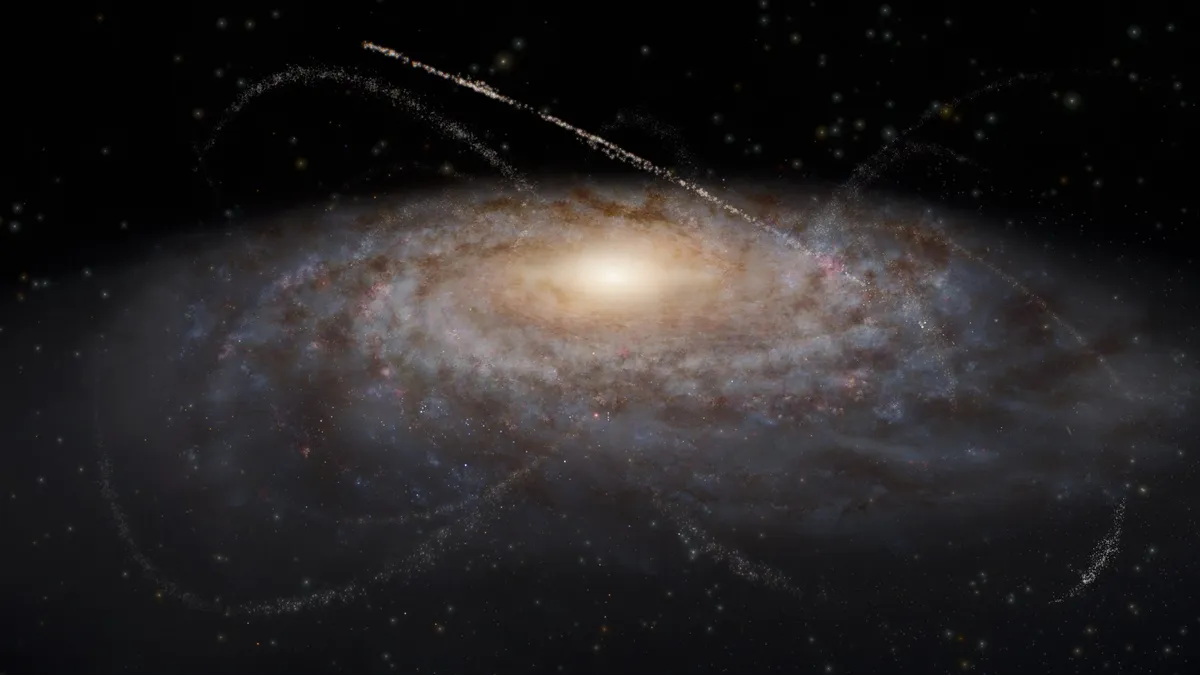
Astronomers have spent years treating distortions in stellar streams — the thin ribbons of stars stripped from smaller galaxies and star clusters by a larger galaxy’s gravity — as indirect evidence of dark matter subhalos, the invisible clumps theory predicts should orbit within a galaxy’s dark matter halo. The logic was straightforward: if a stream shows a kink, a gap, or a bend that visible mass can’t explain, the perturbation likely came from an unseen dark matter clump. A new study out of the University of Washington has made that logic considerably harder to defend.
The team modeled roughly 15,000 stellar streams across four Milky Way-sized galaxies, each with a critical difference from reality: the simulations used only a smooth, uniform dark matter halo with no subhalos at all. After five billion simulated years, only 70 of those 15,000 streams remained perfectly smooth. The rest showed kinks, twists, gaps, and deformations — the same kinds of irregularities astronomers have been watching for in real observations. Lead author Arpit Arora said the host galaxies alone were responsible for producing those distortions.
The study was published August 27, 2026 in The Astrophysical Journal (DOI: 10.3847/1538-4357/ae89af), and the result targets one of the more promising indirect methods for detecting dark matter. The Milky Way’s own gravitational structure — its disk, its bar, its spiral arms — turns out to be enough to rattle stellar streams without any help from dark matter clumps. Simulations using only a uniform dark matter halo with no subhalos found that regular matter alone causes the same kinks, twists, and deformations that researchers had been attributing to dark matter.
The numbers are stark. Of the roughly 15,000 streams the team followed, only 70 survived five billion years of gravitational interaction without developing the kind of irregularity that, in a real observation, would look like evidence of a dark matter encounter. That doesn’t mean dark matter subhalos don’t exist — the standard cosmological model still requires them — but it does mean a kinked stream is no longer a clean signal. The galaxy’s own mass distribution produces the same noise.
For a field that has been looking to stellar streams as a way to map the Milky Way’s dark matter substructure without relying on particle detection experiments, this is a genuine complication. The method still works in principle: a perturbation from a dark matter subhalo and a perturbation from the galactic bar would leave subtly different signatures. But the UW simulations suggest the background contamination from ordinary gravitational effects is far higher than previously appreciated, making it much harder to isolate any single distortion and confidently attribute it to dark matter. The fingerprints astronomers have been hunting may already be indistinguishable from the galaxy’s own gravitational weather.