A 567-million-year-old fossil site in the Mackenzie Mountains rewrites the dawn of animal life
A team from AMNH and Dartmouth has uncovered a 567-million-year-old Ediacaran assemblage in the Mackenzie Mountains, pushing back the dawn of complex animal life by 5–10 million years and suggesting it began in deep offshore waters.
.jpg)
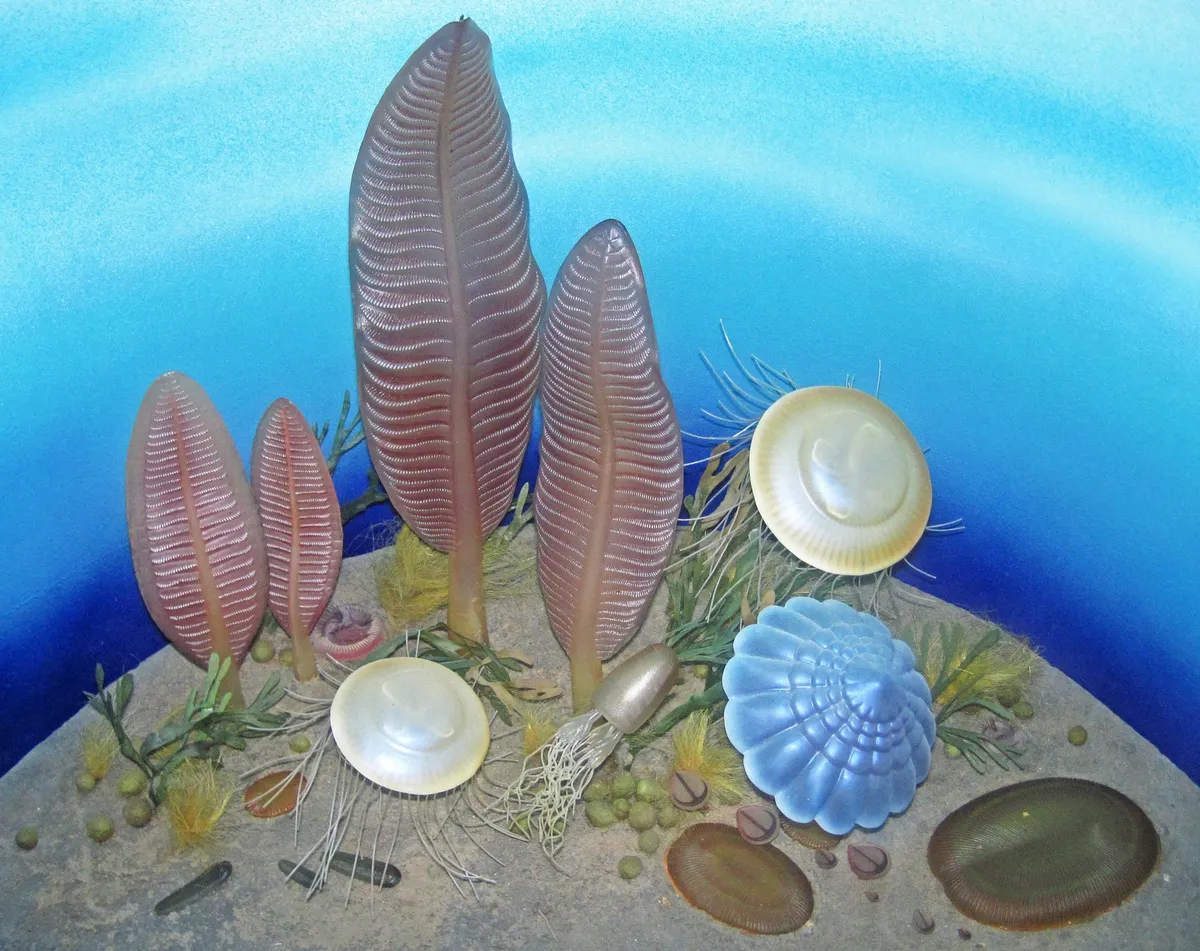
In a remote stretch of the Northwest Territories, roughly 567 million years before the present, the seafloor was busy in ways that paleontology had not previously accepted. A team from the American Museum of Natural History and Dartmouth has uncovered a fossil assemblage in Canada’s Mackenzie Mountains containing more than 100 Ediacaran specimens, including six groups never before recorded in North America. Some of the specimens are dated to about 567 million years old — making them 5 to 10 million years older than comparable fossils found anywhere else, and pushing the dawn of complex animal life, including movement and sexual reproduction, back by a similar margin.
The finds belong to a group known as the Ediacaran biota — a strange assortment of soft-bodied organisms that briefly flourished in the late Precambrian before the Cambrian explosion rewrote the rules of what animals could be. Most famously, the site has produced Dickinsonia, a flat, quilted crawler that is among the earliest known animals to move across the seafloor on its own rather than simply lying in one place. Alongside it the team recovered Funisia, which represents the oldest evidence of sexual reproduction on record, and Kimberella, a possible mollusk relative that would be the earliest known bilaterian — an organism with a symmetric body plan and a through-gut — if its identification holds.
There is also Eoandromeda, which researchers have tentatively read as an early comb jelly. The Mackenzie Mountains assemblage marks the first known White Sea assemblage in North America, placing North American rocks into a conversation that had previously been conducted almost entirely between Australia, Russia, and the White Sea coast itself.
What makes the site substantively interesting is not just that it is old but where the animals appear to have lived. The Mackenzie Mountains were not, in the Ediacaran, mountains at all — they sat on the floor of a deep, stable offshore basin, well below the wave base, in oxygenated waters that did not get churned up by storms or drained by tides the way shallow coastal settings do. Researchers conclude from the assemblage that complex macroscopic life may have first evolved in deep, stable offshore waters before later spreading into the shallows — a reversal of the long-standing assumption that animal complexity had to crawl out of the intertidal.
For a field that has spent decades squinting at the same handful of classic Ediacaran sites and arguing about what, exactly, the things in them were, 567 Ma is not an incremental adjustment. It is a date that rewrites the timing of when animals started moving, eating, and reproducing in the way we recognize as animal behavior. If Kimberella really is a bilaterian at that age, the standard timeline for the evolution of the basic animal body plan shifts forward by tens of millions of years.
The geological setting helps explain why the preservation is so good. Fine-grained marine sediments, low oxygen at the sediment-water interface, and a quiet deep-water environment are exactly the conditions that favor the preservation of soft-bodied impressions — and the Mackenzie Mountains have all three in abundance. That is also why the diversity found here — six groups previously unknown in North America — is itself the news, even before the dating is taken into account.
The practical implication is that the deep-water, offshore hypothesis for the origin of complex life is no longer speculative. It now has a type section.
Sources
- 567-million-year-old fossils rewrite the dawn of animal life — ScienceDaily (republishing American Museum of Natural History press release)
- 567-Million-Year-Old Fossils in Canada Rewrite Early Animal History — Greek Reporter
- Fossils Push Back Origins of Animal Movement by Millions of Years — Dartmouth Faculty of Arts and Sciences