ATLAS and CMS Present Tightest Constraints Yet on Higgs Boson Pair Production
At ICHEP 2026 in Brazil, both CERN experiments reported their most sensitive searches for double-Higgs production — and ATLAS saw a 2.6 sigma excess that particle physicists are taking seriously.
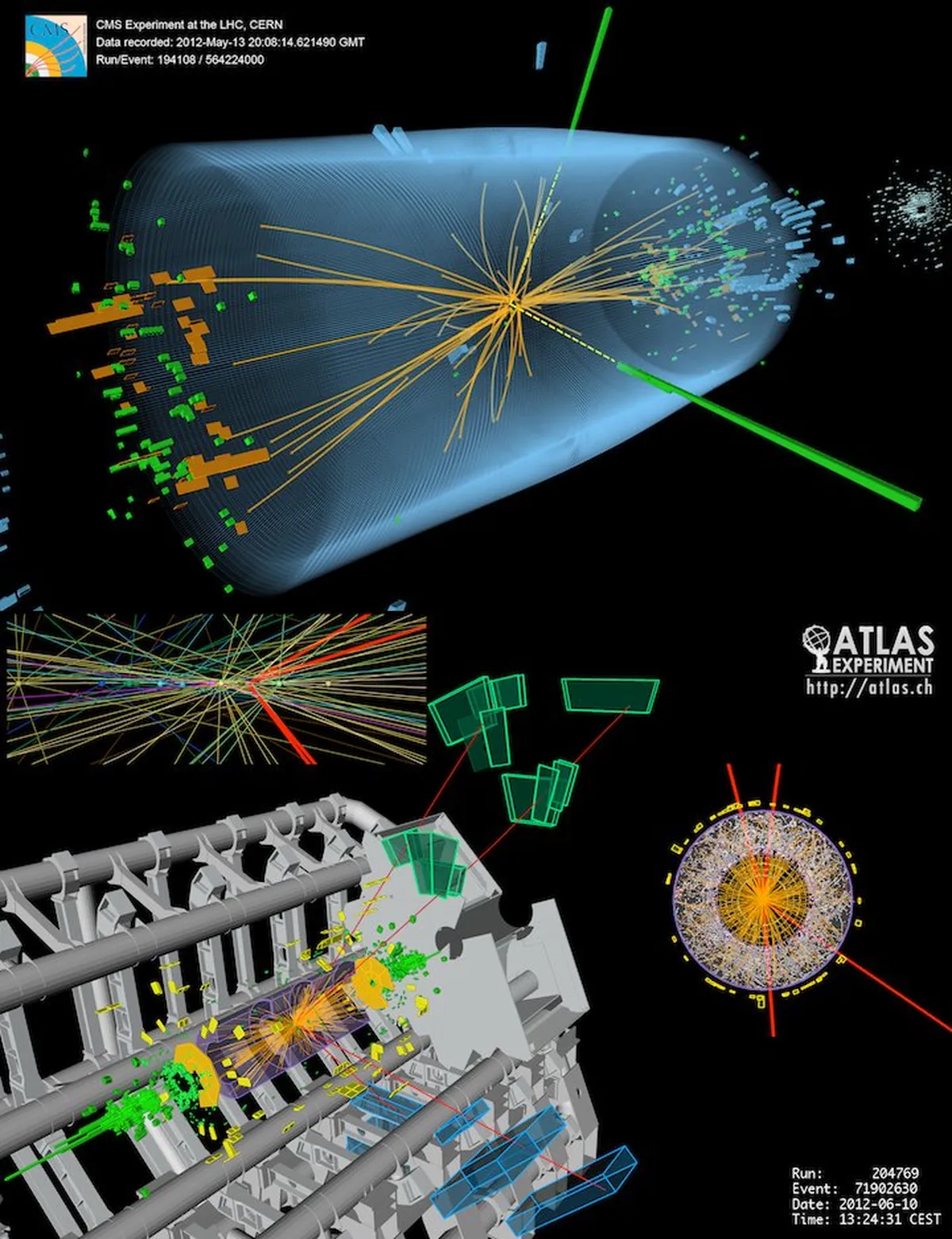

The Higgs boson was discovered in 2012, and every measurement of it since then has been a measurement of what it does when it’s alone. What physicists have been chasing for over a decade is a harder question: what happens when two of them appear at the same time, produced by the same collision. At ICHEP 2026 in Brazil, both ATLAS and CMS — the two general-purpose detectors at CERN’s Large Hadron Collider — presented their most sensitive searches yet for double-Higgs production, and one of them found something worth paying close attention to.
The ATLAS result is the one generating the interest. Searching for Higgs pairs decaying to bottom quarks and tau leptons using 196 inverse femtobarns of data from Run 2 and Run 3, ATLAS measured the double-Higgs production rate at 2.6 plus or minus 1.4 times the Standard Model prediction with 2.6 standard deviations of significance — the most significant excess the experiment has seen in this channel. Expected sensitivity improved by roughly 60 percent over the previous search, which is itself a notable gain and reflects both the additional data and refinements to the analysis. The Nikhef institute’s Tristan Du Pree called the result “an interesting development”, while colleague Pamela Ferrari expressed hope that the full Run 3 dataset — being used here for the first time in this channel — might deliver an initial signal once the analysis is complete.
A 2.6 sigma excess is not a discovery. Particle physics sets that bar at 5 sigma, and 2.6 sigma results have a well-documented history of fading with more data. But the reason this one is being talked about is what double-Higgs production would reveal about the Higgs boson itself. The rate at which the LHC produces Higgs pairs is directly sensitive to the Higgs self-coupling — the strength with which a Higgs boson interacts with itself — which is a fundamental property of the underlying Higgs field and one of the few features of the Standard Model that remains essentially untested. A production rate significantly above the Standard Model prediction would be the first direct evidence that the self-coupling isn’t what the theory says it should be.
CMS, meanwhile, is operating in a different regime. Using 172 inverse femtobarns of data from 2022 through 2024 combined with earlier Run 2 results, CMS set observed upper limits on double-Higgs production at 4.0 times the Standard Model prediction at 95 percent confidence level, constraining the Higgs self-coupling to values between minus 2.5 and 9.4. That’s a wide range by any standard — the Standard Model predicts the self-coupling parameter λ should be 1 at tree level — but it’s the tightest constraint CMS has achieved, and it narrows the region of possible values from both ends simultaneously.
The fact that ATLAS is seeing an excess while CMS has not isn’t a contradiction. The two experiments use different datasets, different analysis strategies, and different optimized signal channels, and their results are statistically independent. If the ATLAS signal is real, CMS should begin to see something consistent with it as its own dataset grows. If it’s a fluctuation, both experiments will converge on that conclusion instead. That’s the point of having two independent detectors covering the same physics.
What comes next is mostly a question of data. Both experiments are still accumulating Run 3 statistics, and CERN’s summary of the results emphasizes the improving constraints each has achieved. The Higgs self-coupling is one of the few remaining parameters of the Standard Model that can only be measured at the LHC, and the path to a definitive measurement — or to ruling out large deviations from the predicted value — runs through exactly the kind of work ATLAS and CMS presented at this conference. The full Run 3 dataset, once analyzed, should either solidify the ATLAS excess into something more substantial or let both experiments set much tighter limits. Either outcome would be a meaningful advance.
Sources
- ATLAS and CMS narrow in on double-Higgs production — CERN
- ATLAS breaks its own record with new search for double-Higgs production — ATLAS Experiment at CERN
- Two Higgs or not two Higgs? CMS advances the search for Higgs boson pair production — CMS Experiment at CERN
- ATLAS experiment sees more hints for double higgs — Nikhef