Einstein's happiest thought, measured in a falling atom
An international team has directly observed the quantum phase of free fall for the first time, confirming that the equivalence principle survives intact when applied to a quantum object.
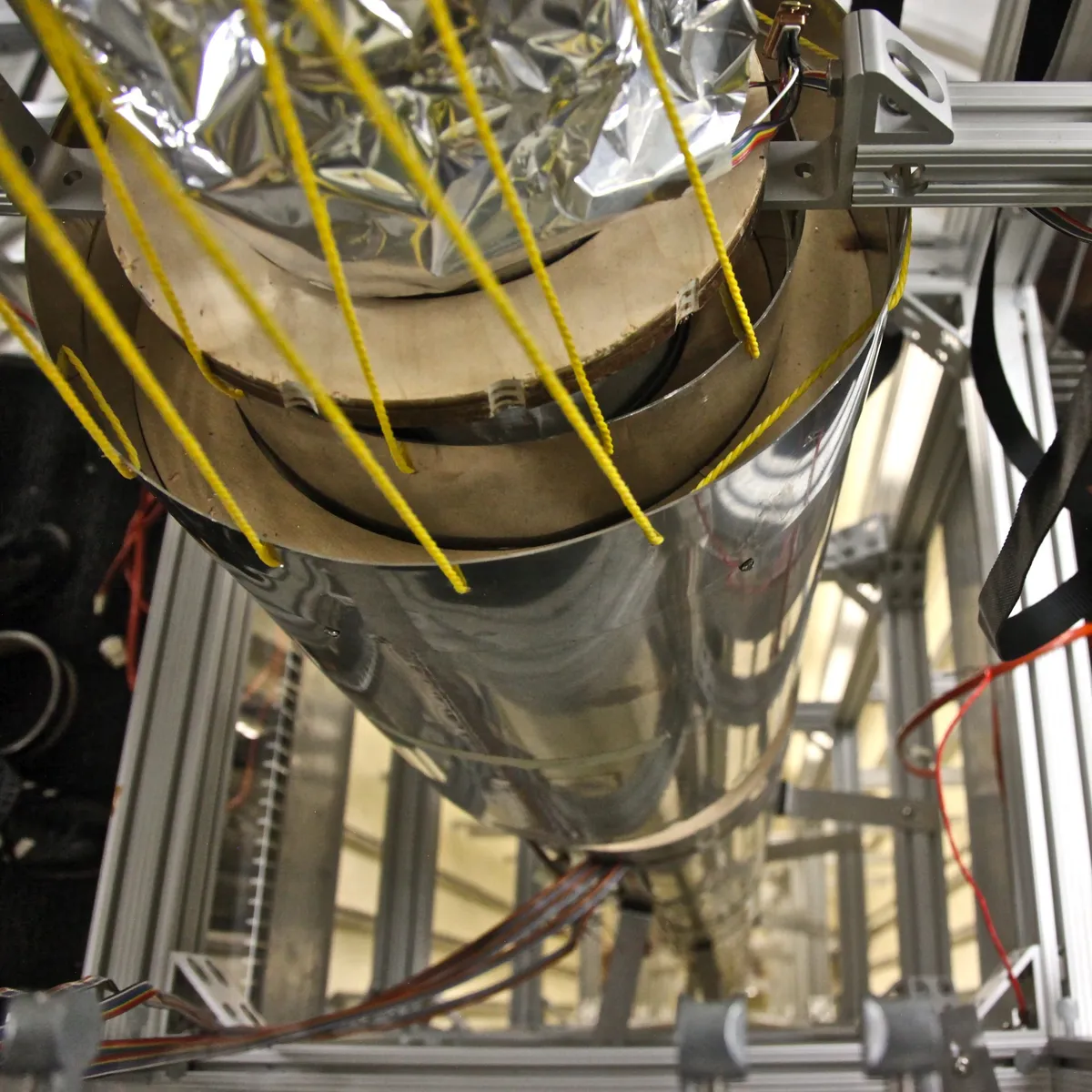
Among Einstein’s many intuitions, the one he reportedly called his “glücklichste Gedanke” — his happiest thought — was that a person in free fall feels no weight, and so locally cannot tell whether they are in a gravitational field or an accelerating rocket. Out of that insight grew the equivalence principle, the foundation of general relativity. For a century it has been tested on clocks, gyroscopes, cannonballs and, indirectly, on neutron stars. What it had never been tested on, directly, was a quantum object in free fall. That changed on 2 September 2026, when a study led from Ben-Gurion University of the Negev, the University of Ulm and the University of Oxford reported the first direct measurement of the quantum phase of free fall, published in Science Advances under the title Observation of the quantum phase of free fall and the consistency with the equivalence principle.
The instrument the team built to do it is something they call a Quantum Galileo Interferometer, and the name is the clearest way to see what they were trying to do. Galileo is supposed to have dropped two balls of different mass from the Tower of Pisa to show they fall at the same rate. The interferometer does the analogous experiment, but instead of two balls it splits the quantum wave of a single rubidium atom into two paths, holds one path stationary and lets the other fall freely under gravity, then recombines the two halves. The phase difference between the falling and the stationary arm is the quantum analogue of the question Galileo asked, and the size of that phase shift is exactly what a straightforward application of Einstein’s equivalence principle to a quantum wave predicts. According to the Oxford press release reported by ScienceDaily, the experiment was carried out using clouds of rubidium atoms cooled to just above absolute zero and manipulated near a specially designed atom chip at Ben-Gurion, and the measured phase matched the predicted value.
The list of authors is striking in its own right: Dobkowski, Trok, Skakunenko, Japha, Groswasser, Efremov, Marletto, Guridi, Penrose, Vedral, Schleich and Folman. Roger Penrose and Vlatko Vedral, both better known for theoretical work on the foundations of physics than for running atom chips, are co-authors; Folman, who led the experiment, has been running atom-chip and matter-wave interferometry at Ben-Gurion for years and is one of the people who pushed the idea that an interferometer of this kind could test the equivalence principle at the quantum level. Live Science’s coverage of the result quotes Folman saying that this is “the first direct measurement of the quantum phase of a freely falling object,” and Vedral emphasising that the point of the experiment is not to unify quantum mechanics with gravity but to check whether the two are in conflict.
That distinction matters, because “Einstein’s gravity meets the quantum world” is exactly the kind of headline that gets attached to this work whether the authors want it or not, and the paper is at pains to draw a narrower line. The result does not show that gravity is a quantum field; it does not detect gravitons; it does not collapse the measurement problem. What it does is confirm that, in the regime the experiment probes, the equivalence principle remains consistent with quantum mechanics — a non-trivial statement, because quantum mechanics and general relativity are built on assumptions about how objects behave in a gravitational field, and there has been no experimental reason until now to believe those assumptions line up cleanly. As Vedral puts it, per the same Live Science piece, there is no conflict between quantum physics and gravity at the scales being tested.
The harder and more interesting question is what happens when the falling object is heavier, or more massive, or more quantum in a way that rubs against collapse models. Penrose has argued for years that gravity might be what causes the wave function to collapse, and that the mass at which this becomes detectable is somewhere between a single atom and a small dust grain. Testing that idea requires repeating the experiment with objects on the heavier end of that range, and the same Live Science report notes that follow-up experiments using nanodiamonds are already underway at Ben-Gurion. The equivalence principle result is the baseline: from here, the question is no longer whether quantum free fall is consistent with Einstein, but where, and how dramatically, it stops being so.
Sources
- Scientists observe Einstein’s gravity in the quantum world — EurekAlert! (releasing University of Oxford press release, peer-reviewed publication notice)
- Scientists observe Einstein’s gravity in the quantum world for the first time — ScienceDaily (republishing University of Oxford release)
- ‘There is no conflict between quantum physics and gravity’: Physicists prove Einstein’s equivalence principle holds true at quantum scales — Live Science (independent newsroom reporting)