LUX-ZEPLIN logs one unexplained event — its strongest dark-matter hint to date
The LUX-ZEPLIN experiment logged a single unexplained particle interaction in 220 days of data — its best dark-matter hint yet, but short of discovery thresholds.
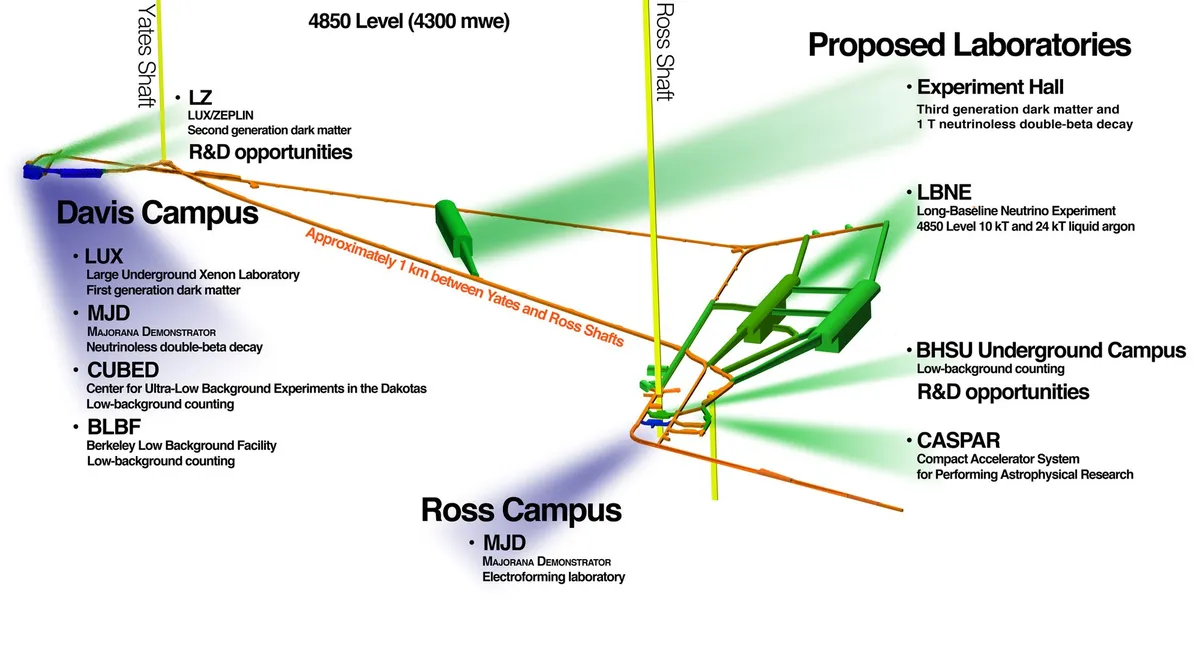

On September 1, 2026, the Department of Energy announced that the LUX-ZEPLIN (LZ) experiment recorded a single particle interaction that researchers cannot explain with known background signals, drawn from 220 live days of data collected between March 2023 and April 2024. The result, presented at the 2026 TeV Particle Astrophysics (TeVPA) conference in Japan, is the most compelling dark matter hint from LZ to date, though it does not meet the statistical threshold for discovery; a paper is to be submitted to Physical Review Letters.
The collaboration filled in the timeline at the conference: on June 16, 2023, the detector — sitting one mile underground in South Dakota — registered a flash/charge event matching no known background and resembling a violent nuclear collision. Scientists stressed caution, noting the chance of that signal being a statistical fluke is about half a percent, still far above the 0.00003% (5-sigma) threshold required for a discovery claim, and said roughly 700 days of additional blinded data are being analyzed.
A separate writeup of the same 220-day dataset quantified the outlier more precisely: the new LZ analysis found one unexpected event consistent with dark matter at a statistical significance of 2.6 sigma, and the odds of known particles producing it are about 1 in 100, well below the 3-sigma ‘evidence’ and 5-sigma ‘discovery’ bars. Physicists presenting at the TeV Particle Astrophysics meeting in Tendo, Japan called the result intriguing but emphasized that more data are needed.
If the lone interaction is in fact a dark-matter particle, the DOE’s account notes the WIMP would likely carry a mass of at least 200 GeV/c². That figure sits well above the lighter candidates historically targeted by direct-detection experiments, and it emerges directly from the energy profile of the single recorded scatter rather than from any broader excess.
What remains is a careful waiting game. The half-percent fluke probability and 2.6-sigma rating are far from the evidentiary lines the field has set for itself, and the ~700 days of blinded data now under analysis will either dilute the event into background or lend it the weight that turns a compelling hint into something stronger. Until then, the South Dakota detector’s single violent blink stands as the cleanest dark-matter candidate LZ has yet produced — and a pointed reminder of how thin the boundary is between a noise fluctuation and a discovery.