One-Atom-High Steps Turn Out to Be Rails for Superconducting Vortices
Researchers at Japan's MANA found that atomic-scale surface steps guide superconducting vortices, letting them move over a thousand times more easily in one direction — a result with implications for low-power superconducting devices.
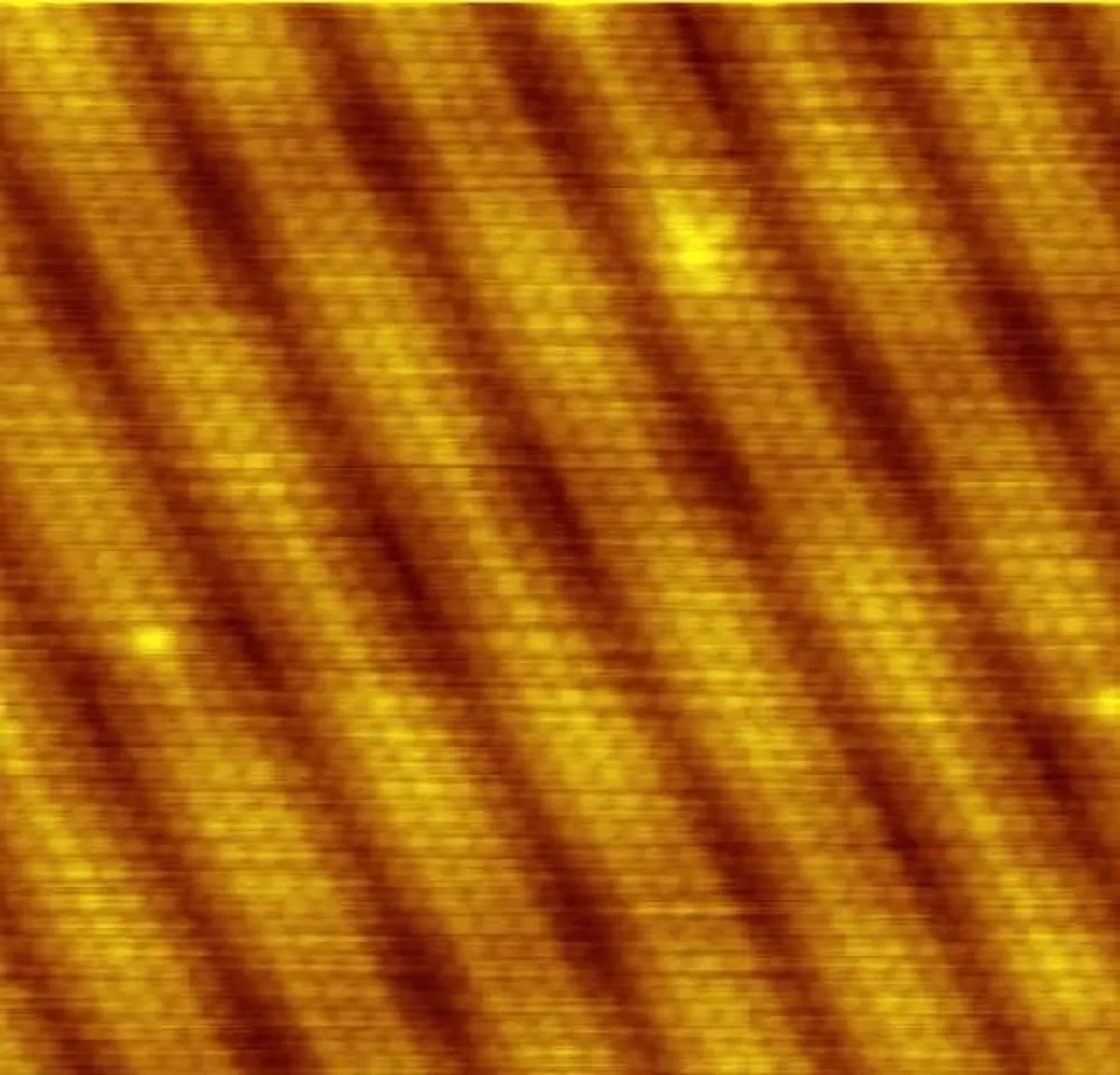

One of the awkward facts about superconductivity is that the current-carrying state comes with an uninvited guest: quantized vortices, whirling threads of magnetic flux that thread through the superconductor and refuse to sit still. Get them moving and they dissipate energy, which is the last thing you want in a device built to lose none. A team at Japan’s Research Center for Materials Nanoarchitectonics has now found that atomic steps just one atom high on a superconductor’s surface can act as rails that guide these vortices, channeling them along preferred paths instead of leaving them to wander — and the effect is dramatic.
In ultrathin superconductors, the researchers showed that vortices move more than 1,000 times more easily along the atomic steps than across them, with the strongest directional preference appearing at intermediate magnetic fields. The anisotropy isn’t a fixed property of the material, either: the two reports agree that it can be tuned by temperature and magnetic field, which is what turns a laboratory curiosity into something you might actually build with. A vortex that can be steered is a vortex that can be managed.
The reason this matters goes back to why vortex motion is a problem in the first place. In an ideal superconductor, current flows with zero resistance; but expose the material to a magnetic field and flux vortices form, and any current pushing against them drags them sideways, dissipating energy in the process — the phenomenon engineers know as flux flow. Conventional strategy has been to pin the vortices down with defects and impurities, essentially anchoring them in place. What the MANA team demonstrated is a different philosophy: rather than trap the vortices, give them a direction of easy travel and make the perpendicular direction hard.
That 1,000-fold ratio between along-step and across-step motion is what makes the finding more than a materials-science footnote. It means the surface topology — something as mundane as a step edge left by how the crystal was grown — functions as a genuine control element at atomic scale. For devices built from ultrathin superconducting films, where there is no bulk material to hide defects in and the surface is the device, having a knob that steers vortex traffic could matter a great deal.
The researchers’ own framing points at low-power superconducting devices as the application horizon: if vortex motion can be guided rather than merely suppressed, the dissipation that normally accompanies it might be designed around rather than endured. The tunability by temperature and magnetic field suggests the steering could be switched or adjusted in operation, not just engineered in at fabrication time.
None of this is a working device yet, and the usual distance between an atomic-scale demonstration and a deployable component applies. But the underlying result is the kind physicists like: an unexpected degree of control discovered in a place nobody had thought to look, one atom high, sitting on the surface of a superconductor all along.