Quantum Entanglement Sustained Over 62 Km of Live Commercial Fiber
.jpg)
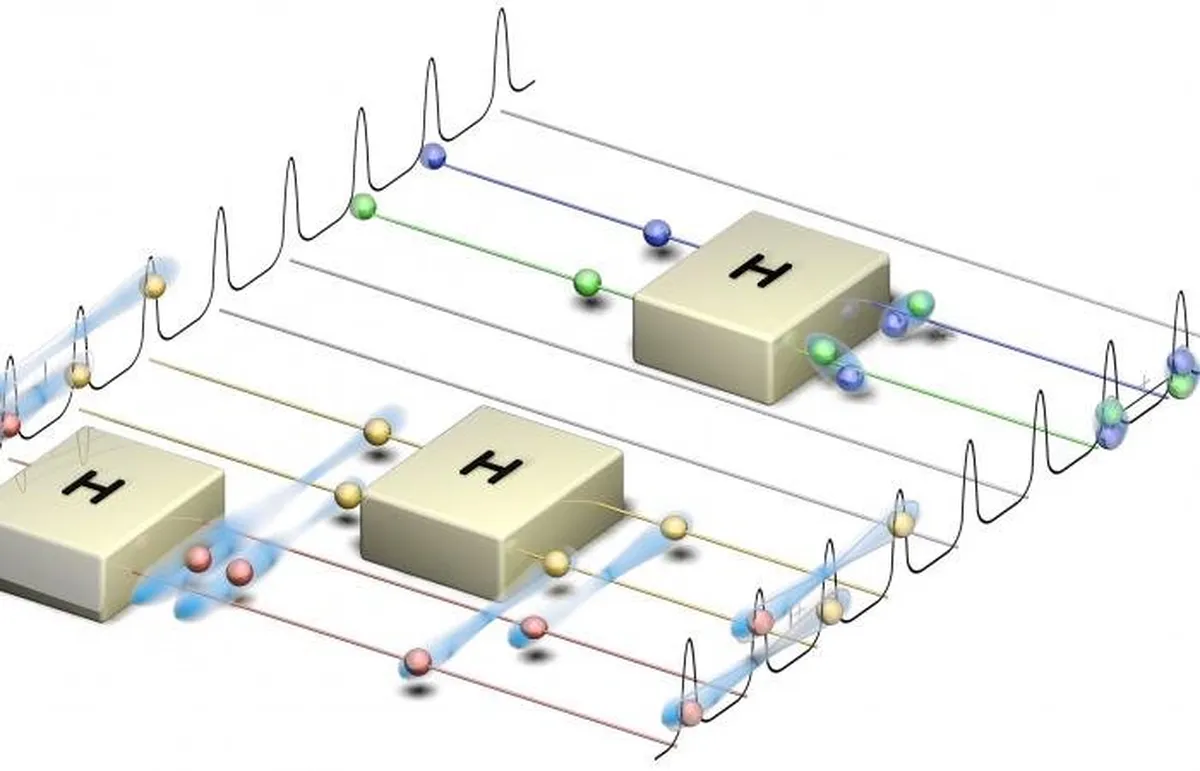
Last August, researchers from NIST, the Joint Quantum Institute at UMD, and Qunnect successfully distributed polarization-entangled photons over 62 km of live commercial aerial fiber for a continuous 24-hour trial, achieving ~1,500 entangled pairs per second with 92.8% operational uptime while using automated compensation devices to counter the environmental noise that typically degrades delicate quantum states in uncontrolled settings.
The experiment operated outside idealized laboratory conditions, relying instead on hardware that actively tracks and corrects phase shifts caused by temperature swings and mechanical stress in long cable runs. Maintaining those states requires compensating for both movement and atmospheric variation without dropping the transmission, and doing so across a full day proves the systems can keep pace with urban infrastructure dynamics rather than requiring isolated thermal blankets or vacuum chambers.
That sustained performance was recently subjected to formal scrutiny, with a peer-reviewed analysis confirming that entanglement survived across 62 kilometers of leased aerial telecom fiber — much of it suspended directly from utility poles — proving the setup could handle real-world conditions without compromising coherence.
The result lowers infrastructure costs for quantum key distribution by showing that existing overhead plant can serve as a transport layer instead of requiring new trenching, effectively cutting through the capital barrier that has historically stalled deployment. Quantum communication has long faced friction not from theoretical limitations, but from the physical reality that every dedicated fiber run demands expensive digging, while overhead lines have rarely been treated as viable conduits for photonic qubits.
The practical implication extends beyond simple cost savings. A functional Quantum network depends on scalable physical layer management, and the ability to run automated compensation algorithms over live, noisy lines proves that stability can be engineered into existing plant rather than demanding completely fresh builds. Nearly 93% operational uptime across a full day demonstrates that environmental fluctuations — which usually force rapid polarization misalignment — can be tracked and corrected in real time without breaking the quantum link entirely.
The remaining question is how quickly this architecture can scale when moving from a single 62-kilometer span to wider metropolitan routing. Existing grids already carry dense classical traffic, and overlaying quantum key distribution on top of that footprint requires maintaining low latency while the compensation hardware tracks atmospheric shifts, thermal expansion in cables, and mechanical flex under varying weather patterns. Researchers have already cleared the foundational hurdle by proving entanglement holds its state through standard aerial lines; commercial integration will now test whether automated polarization tracking remains stable as links multiply and network topology grows from isolated demonstrations into a unified routing fabric.