Astronomers discover S301, the fastest known star in the Milky Way orbiting Sagittarius A* at over 8% the speed of light
Star S301 orbits our galaxy's supermassive black hole in just 8.7 years, approaching close enough to potentially measure the black hole's spin within a decade.
.jpg)
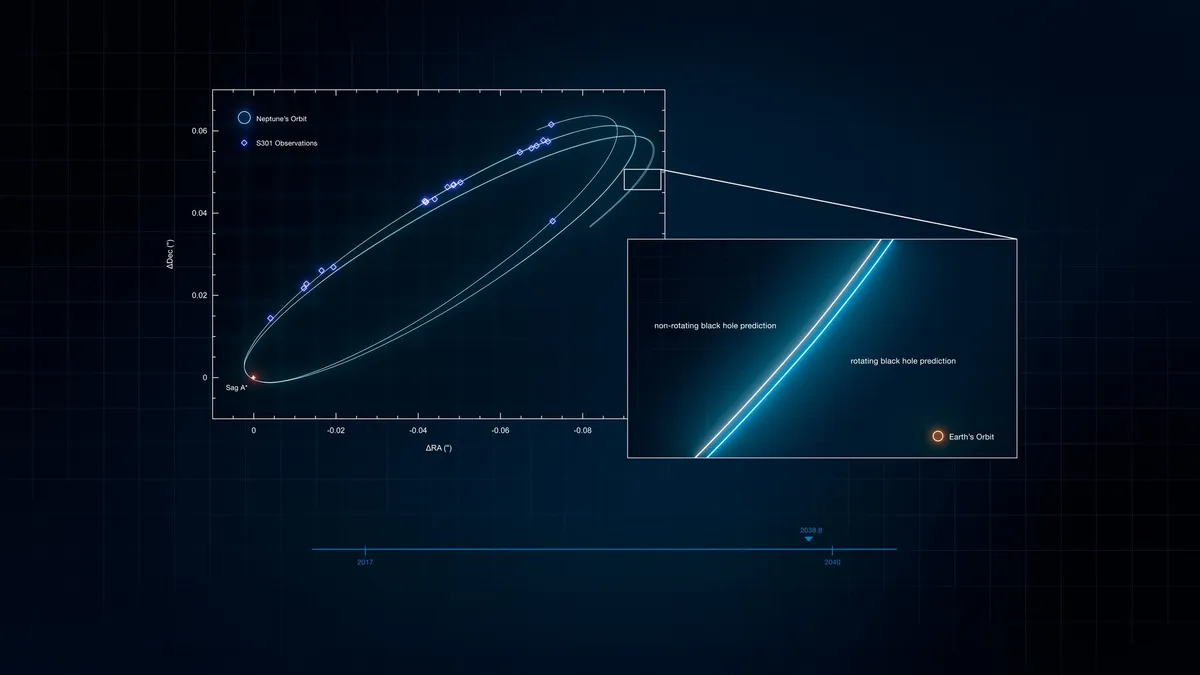
Astronomers have identified a star moving faster than any other known in the Milky Way, locked in a tight orbit around Sagittarius A* that brings it within twelve times the Earth-Sun distance of the supermassive black hole at our galaxy’s center. The star, designated S301, reaches velocities of 25,000 km/s — more than 8% the speed of light — and completes a full orbit in just 8.7 years.
That orbital period makes S301 the fastest-known star in the galaxy by a considerable margin, and its closest approach of roughly twelve astronomical units is unprecedented for any star tracked around Sagittarius A*. For context, Mercury orbits our Sun at about 0.4 astronomical units; S301 is swinging past a four-million-solar-mass black hole at a distance only modestly larger than Saturn’s orbit.
The discovery matters for reasons beyond the velocity record. S301’s trajectory is close enough and fast enough that its motion should be directly sensitive to the black hole’s spin through an effect called Lense-Thirring precession — a subtle frame-dragging predicted by general relativity where a rotating massive object warps spacetime around it. Measuring this precession would give us the first direct handle on how fast Sagittarius A* itself is rotating, something no previous stellar orbit has been tight enough to reveal.
Current near-infrared interferometry can already track S301’s position, and future spectroscopic measurements should be able to pick up the velocity shifts that betray the black hole’s influence on spacetime. The researchers estimate that within the next ten years, observations of S301 could yield a measurement of Sagittarius A*’s spin — a fundamental parameter that has remained stubbornly inaccessible despite decades of studying the stars clustered around our galaxy’s center.
The broader context is that Sagittarius A* has been a remarkably well-behaved laboratory for testing Einstein’s theory in strong gravitational fields, thanks largely to the monitoring of stars like S2, which completed a famous close pass in 2018. S301 is considerably closer and faster, which means any deviations from predicted orbital motion — whether from spin effects or something more exotic — should be easier to tease out. The star is essentially a probe dropped into the deepest part of the gravitational well we can currently observe.
What makes this a practical prospect rather than a distant hope is the convergence of observational capability and orbital geometry. S301 was found in data that will continue to accumulate, and each additional year of monitoring tightens the constraints on its trajectory. The 8.7-year orbital period means astronomers will see multiple close approaches within a single career, each one an opportunity to watch spacetime itself twist around a collapsed object four million times heavier than our Sun.
Sources
- Milky Way’s fastest star orbits our supermassive black hole so closely it feels its spin — European Southern Observatory
- Scientists just found the fastest known star in the Milky Way. It zooms around our black hole at 15,500 miles per second — Space.com
- Discovery of a star sensitive to the spin of Sagittarius A* — Nature