NASA's PUNCH Mission Predicts a Solar Storm's Arrival to Within 30 Minutes
NASA's PUNCH mission predicted the arrival of a May 31, 2025 coronal mass ejection to within 30 minutes, a tenfold improvement over the previous 12-hour forecast window.
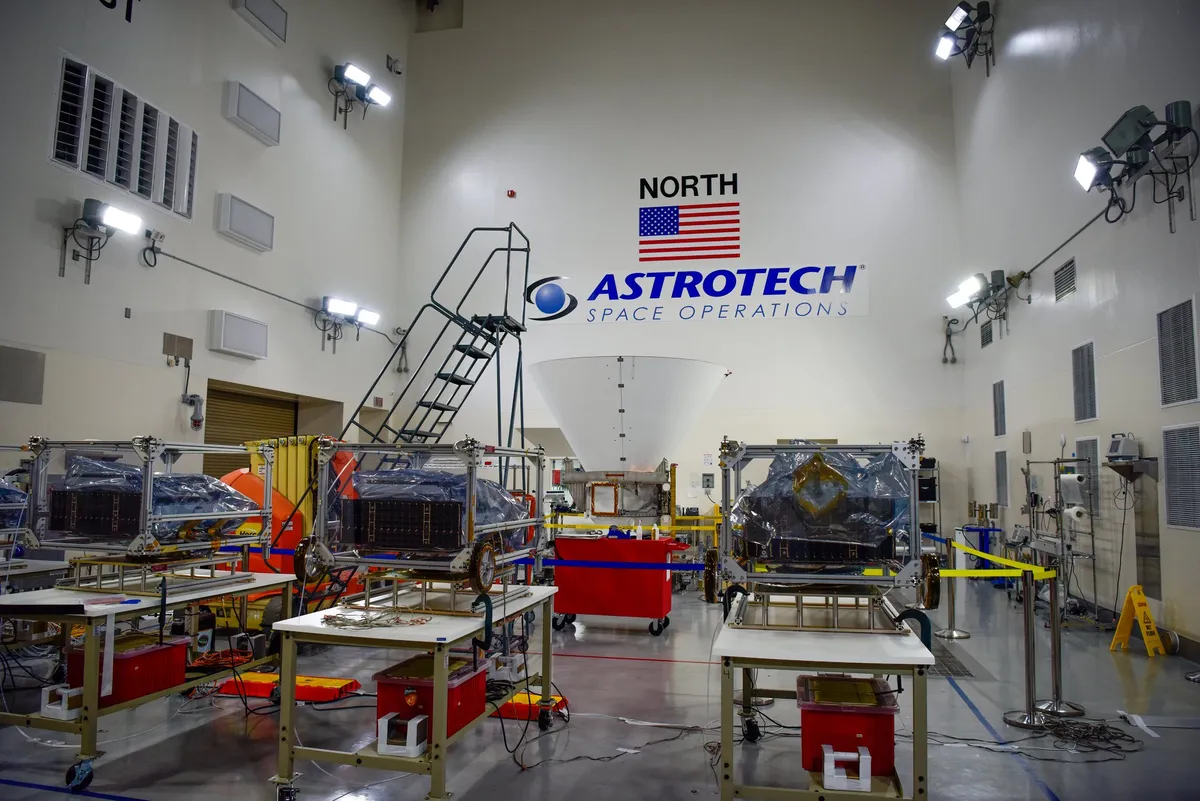
.jpg)
On May 31, 2025, a coronal mass ejection erupted from the sun, and NASA’s four-satellite PUNCH mission — launched in March 2025 to provide continuous 3D observations of the inner solar system — predicted the storm’s arrival at Earth to within 30 minutes, a tenfold improvement over previous 12-hour forecast windows.
That result came from the mission’s first major test under real storm conditions. Using continuous imagery from PUNCH, scientists predicted the near-Earth arrival of a solar eruption to within 30 minutes. Principal investigator Craig DeForest described the advance as “the space weather equivalent of going from a steam engine to a modern internal combustion engine.”
The important shift is in what forecasters can do with the information. A 12-hour arrival window tells operators that a storm is coming sometime during a full day; a 30-minute window tells them when the leading edge will actually hit. That is the difference between a precaution that has to cover everything for an entire shift and one that can be timed precisely.
The capability comes from the mission’s geometry. Instead of a single spacecraft watching the sun from one angle, PUNCH’s four satellites work together to build a continuous three-dimensional view of the inner solar system. That allows forecasters to watch a coronal mass ejection’s structure, speed, and direction evolve as it travels, rather than trying to infer all of it from one vantage point.
For a mission that had launched only that spring, the May 31 event was a remarkably early payoff. The results were presented August 4, 2026 at the Committee on Space Research meeting.