LUX-ZEPLIN logs a single event that could be the first whisper of dark matter
A single anomalous event in the LUX-ZEPLIN dark matter detector has reached 2.6 sigma, a tentative signal that falls well short of discovery and now awaits confirmation from other experiments.

On 1 September 2026, at the TeV Particle Astrophysics conference in Japan, a study led by University of Bristol astro-particle physicist Dr Sam Eriksen presented a potential first hint of a dark matter interaction in LUX-ZEPLIN (LZ) data, a result the university’s press release says Berkeley Lab also announced. The finding hinges on a single unexplained particle interaction pulled from 220 live days of data taken between March 2023 and April 2024.
That event registered at 2.6 sigma — about a 0.5% chance of being a known background fluctuation — with an implied WIMP mass of at least 200 GeV/c², according to the Bristol-led analysis. It is, by the same account, well below the 5-sigma discovery threshold the field treats as the bar for a real detection.
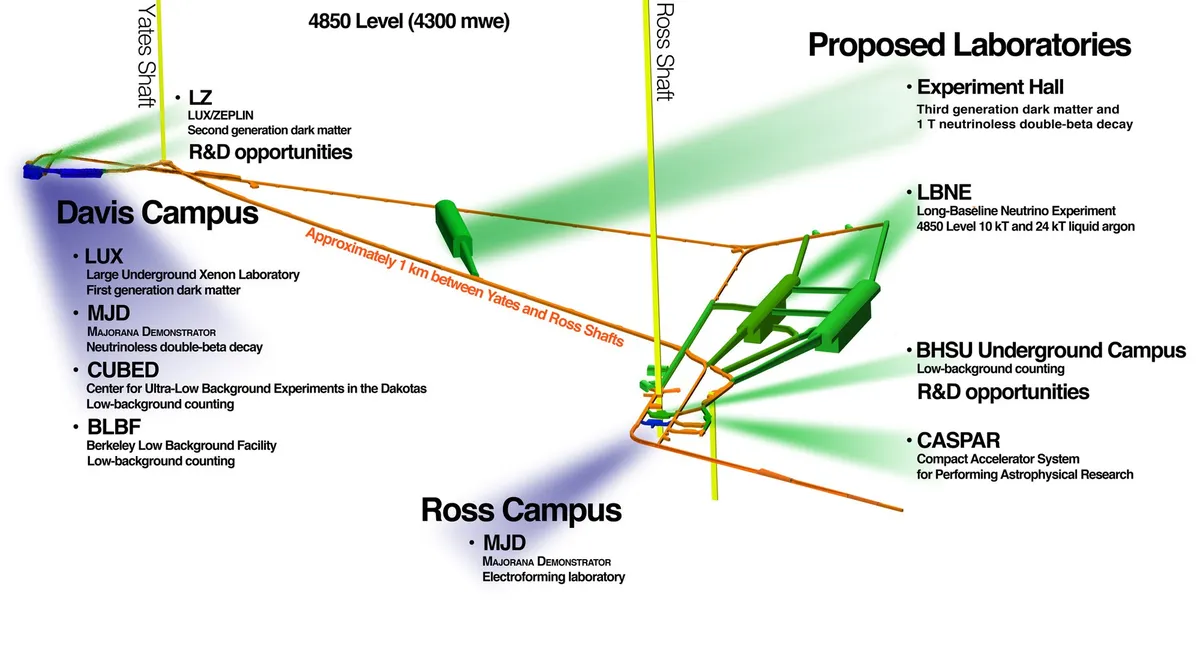
The instrument behind the measurement sits nearly 1.5 km underground at the Sanford Underground Research Facility in South Dakota, and within that 220-day run it logged one event on 16 June 2023 that could be dark matter or a new particle interaction, ABC News reported. The outlet’s coverage independently confirms the 2.6 sigma figure and the gap below five sigma.
Caution is the shared tone. A 0.5% background probability is genuinely interesting, but it remains far short of the 5-sigma discovery threshold physicists require before claiming a detection. Both the Bristol release and the ABC reporting are explicit that one event, however tantalizing, does not constitute a discovery.
The obvious next step is repetition. Physicists quoted by ABC say more detections are needed, and that other detectors such as XENON and PandaX will be asked to check whether the signal shows up in their own data. A single blip in one experiment becomes a finding only when a second, independent instrument sees the same thing.
Until then, the June 2023 event sits in the record as exactly what the researchers presented it as: a hint. LZ was built to sit quietly underground for years waiting for a particle most of physics believes is there but no one has ever directly caught, and one interaction out of 220 days is the closest that patient watch may have come so far.